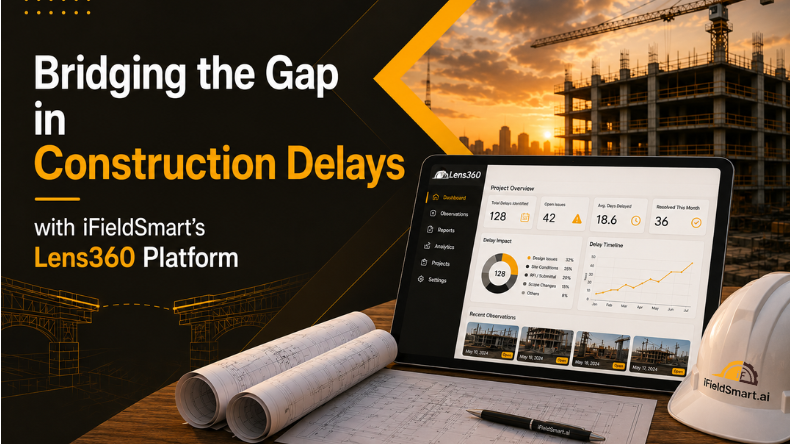


Construction delays often occur because project teams struggle to keep BIM models aligned with actual jobsite conditions. When field progress differs from design intent, issues can go unnoticed until they become costly rework or schedule delays. iFieldSmart’s Lens360 bridges this gap by connecting 360° site capture with BIM models, giving teams a real-time view of construction progress and helping identify issues before they impact delivery.
Capturing Site Reality in Minutes
Lens360 begins with simple on-site documentation. Walking the jobsite with a 360° camera is all it takes. The system automatically maps each capture by date and location. Users can visualize progress room by room. The AI that helps Lens360 organizes visuals into structured records. This removes the chaos of missing or duplicated photos and allows teams to review site progress without manual sorting. Every space—interior, exterior, or MEP—is visually tracked with consistent documentation.
Making the Invisible Visible with BIM Comparison
Lens360 bridges drawings and built reality. Teams can upload their Revit or Navisworks models to the platform. Every 360 capture aligns with the model, showing what matches and what doesn’t. This BIM-to-field comparison highlights layout errors and uneven framing before it becomes costly rework. Annotated screenshots can be shared with contractors for verification.
Work Smarter, Not Harder
iFieldSmart empowers your team with AI-driven efficiency to simplify scheduling, boost collaboration, and keep projects on track.
Schedule a MeetingThis side-by-side view prevents guesswork. Managers no longer rely on subjective descriptions or incomplete reports. The comparison sharpens field awareness and improves confidence in project accuracy.
Turning Data into Connected Insights
Lens360 takes visual capture further by connecting data from multiple tools. Users can drop RFIs, drawings, or submittals directly onto 360 images. Integrations with Procore and Autodesk allow automatic syncing, linking models, and site visuals in one connected workspace. Every image becomes smarter—with attached specifications, observation notes, and next steps.
This integration reduces confusion between multiple systems. Teams can identify where an RFI is, why it matters, and who needs to act next. Lens360 eliminates confusion and speeds up approvals by linking visual evidence to structured data.
Observation Reports that Drive Action
Delays often grow from unnoticed issues. Lens360’s observation tools ensure every problem is captured early. Field teams can log issues directly on 360 captures—tagging exact locations, attaching images, or linking relevant RFIs. Managers viewing from the office can instantly see the context behind every concern.
With report exports and AI summaries, inspection findings become easy to share. Safety incidents, quality concerns, or incomplete scopes can be traced and tracked from identification to resolution. This workflow brings accountability into focus, shortening response cycles and reducing dispute risks.
Monitoring Real-Time Trade Progress
The platform’s Trade Progress Dashboards visualize how each trade is performing. Progress can be broken down by trade, location, or floor. Dashboards show completion percentages, delays, or unstarted sections at a glance. Managers can easily detect bottlenecks by viewing visual evidence tied to progress metrics.
This clear reporting turns routine site walks into measurable insights. Instead of chasing updates across emails or spreadsheets, teams see a transparent status view of every system—straight from actual jobsite visuals.
Reducing Delays through Early Detection
Lens360’s biggest value lies in the time gained from early detection. Field-to-BIM comparisons immediately highlight misaligned work. Connected data alerts trigger action without waiting for manual updates. AI observation summaries flag potential risks as soon as they appear.
Project managers gain the confidence to make fast, informed decisions. Missing insulation, incomplete mechanical runs, or delayed finishes become visible before handover deadlines are at risk.
Uniting Teams Across Field and Office
Delays come from communication gaps, not technical issues. Lens360 closes this gap by keeping everyone aligned to the same visuals. Designers, contractors, and owners access one platform—a single source of truth for project progress.
This unity helps eliminate redundant site visits and misaligned expectations. Office engineers can verify installations remotely, saving time and travel costs. Trades can use shared visuals to plan sequences and reduce clashes. The outcome is smoother coordination and fewer standstills.
Connecting AI and Accountability
Beyond visual capture, Lens360’s AI brings jobsite data, BIM models, and project documentation together. It creates a connected workflow for stakeholders. Integrations with platforms Procore and Autodesk ensure that teams work from the latest information, reducing communication gaps and improving coordination.
Accountability grows stronger when every progress photo, observation, and RFI ties back to visual evidence. No more disputes about when or where work occurred—Lens360 timestamps every capture. This record builds a transparent chain of accountability across teams.
Enhancing Project Handover and Operations
Once construction ends, Lens360’s record becomes a digital reference for facility managers. Linked submittals and O&M details are accessible directly from 360 images. Facility teams can click through spaces, view connected equipment data, and trace installation history.
This capability smooths the transition from construction to operations. Handovers are no longer binders or scattered files—they’re living, visual databases that keep knowledge intact.
How Lens360 Closes the Delay Loop
Traditional delay management often starts after the problem. Lens360 closes that loop by combining three layers of visibility:
- Reality capture: 360 site imaging with chronological and spatial indexing.
- Model comparison: BIM overlays that reveal mismatches automatically.
- Data integration: RFIs, drawings, and submittals linked to each 360 view.
This connection helps teams monitor progress with greater accuracy and confidence. Every issue is documented with clear proof. Every trade’s output ties to a percentage-ready view. Every stakeholder shares an aligned context.
With this structure, causes of delay—like missing coordination or communication lag—are detected early. Decision-making becomes proactive.
A Smarter Way Forward
In essence, Lens360 does one thing better than any workflow: it keeps projects aligned with reality. By blending 360° visuals, BIM comparisons, and integrated data, it stops delays before they spread. Every walk through the site becomes a decision tool.
As construction projects grow complex, time saved on coordination directly saves cost. Lens360 gives teams that edge—clear sight, shared accountability, and measurable progress. Instead of chasing updates, they stay ahead of them.
Lens360 bridges the gap between BIM and on-the-jobsite, providing stakeholders with a shared, accurate progress evaluation, resulting in fewer surprises, faster choices, and on-time construction projects.