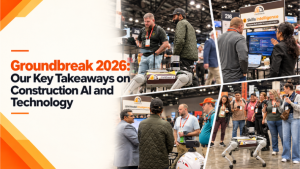


Day 1 of the DBIA Design-Build Conference & Expo in Cleveland showcased what is changing the future of project delivery. At Booth #131, we discovered something interesting: builders are no longer questioning if Artificial Intelligence (AI) has a role in construction. The question is when can it be implemented.
One of the main issues was the fragmented nature of project information and documentation. Project team members are looking for AI technology that will help comprehend construction domain and reveal inconsistencies and gaps within project information. Other issues were determining gaps in project scope and reconciling Building Information Modeling (BIM) with the field conditions.
The upcoming and evolving expectations of the construction industry were discussed. In particular, the type of AI that will allow for business process re-engineering and offer intelligent augmentation of construction workers.
Work Smarter, Not Harder
iFieldSmart empowers your team with AI-driven efficiency to simplify scheduling, boost collaboration, and keep projects on track.
Schedule a MeetingTeams are drowning in documents that don’t talk to each other
The interests of construction professionals align with our vision to develop an AI-powered assistant for the construction industry. iFieldSmart understands the problems faced by construction professionals and is addressing the issues with AI. It helps construction professionals be more efficient in document management and provides clarification and assistance in conceptualizing ideas by interpreting construction documentation and measuring distances, to name a few. Which RFI led to that bulletin? Which revision does this submittal answer? What did the change cost?
During our demonstrations, AI-assisted reviews highlighted gaps across different trade submittals. A plumbing insulation review identified missing insulation thickness details by pipe size, local code compliance confirmation, and the manufacturer’s certificate. An electrical submittal review noted an OA grille clearance concern and incomplete duct insulation product data.
AI helps teams to recognize documentation gaps, identify specification conflicts and locate coordination issues prior to them causing costly delays and rework in the field.
Submittal review is still a bottleneck
Submittals came up again and again, from general contractors and subcontractors alike. The typical ask was to check a submittal against its spec section, or to find out which submittals a division requires in the first place.
The reason this keeps coming up is simple. Reviewers have to hold a long spec and a long submittal in their heads at once, usually while handling other work. The things that get missed are the unglamorous ones. In our demo review of a plumbing insulation submittal, the gaps were insulation thickness by pipe size, a statement of local code compliance, and the manufacturer’s certificate. None of it is exotic. All of it causes a resubmittal when it’s caught late.
AI helps most as a first pass. It reads both documents, lists what’s missing, and suggests what to request. The reviewer still decides.
Coordination is moving from the model room to the field
BIM and VDC people asked about clash review. So did subcontractors, owners, and architects, who asked something slightly different: does what’s built match the model? Questions like “check our Level 2 plumbing against the model” or “what are the current conditions in this corridor” came from people who aren’t sitting in Navisworks all day.
A notable change is the reliance on model-based coordination by the front-line workers. Formerly a function of a specialist team, it is now expected that front-line workers will be able to directly contact the model to answer specific location-based questions (i.e., what is the level in that corridor, what is the unit number). The demonstrations showed the value of integrating field conditions with BIM model coordination. The teams reviewed 360 field captures to corroborate construction conditions that may not be represented in plans or design documents. Lens360 further extended this capability by integrating reality capture and field observations with the BIM model validation process.
A fair warning. Results on a live job depend on how current the model is and how reliable the field data is. AI doesn’t fix a stale model. It just makes the gaps easier to see.
Scope gaps are still where change orders start
Visitors focused on how trade scopes overlap, specifically between electrical and mechanical contractors. They also explored how AI could assist in the development of trade-specific scopes of work. The discussions touched on traditional coordination problems including grounding, control wiring, mechanical equipment connections, and air barrier penetrations.
These intersections result in costly delays if discovered after a buyout or during the installation stage. If responsibilities are not clearly defined, contractors may take on additional work, possibly consuming a contingency or allowable, and/or change orders may be generated out of scope.
It is in the best interest of all involved to define and address scope gaps that may exist, and in doing so, potentially address scheduling and commercial issues before they arise.
Builders want AI that acts, with a person in charge
Many of the questions weren’t really questions. They were instructions. Draft the reply. Assign it to the trade. Turn that email into an RFI. Build the log. Prep the coordination meeting.
That is the move from AI that answers to AI that works, often referred to as agentic AI in the construction industry. This distinction is important in construction as a drafted RFI, submittal response, coordination instruction, or contractual communication can have downstream consequences. AI can create the information and organize the required actions; however, control over approvals and external communications should remain in the hands of the project professional.
The custom workflows people asked for
We had some interesting conversations about the workflows teams wanted and are currently available in AI skills. These included tracking drawing revision history across RFIs and bulletins; merging RFIs, submittals, and models for integrated MEP coordination; and identifying change orders absorbed through buyout or contingency, and generating a pre-bid RFI log from drawings and specs.
iFieldSmart AI identified the project information, the connected data sources, and the steps in the workflow required to support the request, and thus defined a new use case. So, rather than work around the constraints of existing AI, we defined AI skills to address challenges in the construction industry.
What Day 1 Revealed About the Future of Construction AI
The conversations at DBIA 2026 illustrated how the construction industry is starting to see artificial intelligence (AI) differently. There is less interest in how AI can be used to automate isolated tasks and more interest in how it can integrate various forms of intelligence across the design-build process to assist in making decisions.
Some of the top priorities for the industry included:
- AI to support decision-making:
The goal is to obtain actionable project information and insight on time, as opposed to relying on manual review of project information. - Early trade partner engagement:
Better scoping and early engagement of trade partners can address conflict and responsibility gaps, for example, coordination of vertical construction before horizontal trade work. - Automated Quality Assurance and Quality Control:
The use of AI to assist in the identification of potential design and construction concerns. - Connected BIM:
Integration of building information modeling with reality data, as-built, helps the team understand the intent of the design and align with the as-built installation.
FAQ’s
Can AI review a construction submittal against the specification?
Yes, as a first pass. It can compare the two documents and flag missing items such as insulation thickness or code compliance statements. A qualified reviewer still makes the approval decision.
What is scope gap analysis?
It’s the process of finding work that no trade owns, or that two trades both claim, by comparing drawings and specifications. AI speeds up the search so coordinators can focus on resolving what it finds.
Can AI compare field conditions to a BIM model?
Workflows for this exist. Accuracy on a live project depends on the quality of the model and the field information available.
Explore the Future of Construction AI at DBIA 2026
Day 1 of DBIA 2026 revealed the eagerness of the construction industry to advance past simple information retrieval. Construction professionals want AI that understands project context and helps solve problems. It includes, connecting drawings and specs, resolving drawing coordination issues, assisting with compliance reviews, and offering actions to facilitate resolution.
The next step is beyond automated workflows that combine design information and construction project documentation, BIM models, and the true conditions of the field.
DBIA 2026 attendees are invited to stop by booth #131 to learn about innovation in the construction industry, including AI for Scope Intelligence and Submittal Compliance, BIM coordination, and Lens360.
iFieldSmart AI can help construction professionals address workflow requirements, project challenges, and ideas for things they would like AI to do. Attendees of DBIA 2026 can leave with a new approach to an old construction challenge.