

Introduction.
The construction industry requires stakeholders like general contractors and other participants like project managers to achieve precision, speed, and clarity for new and existing projects. 2D deliverables are not enough, as ground personnel require insights that are tangible and real-time.
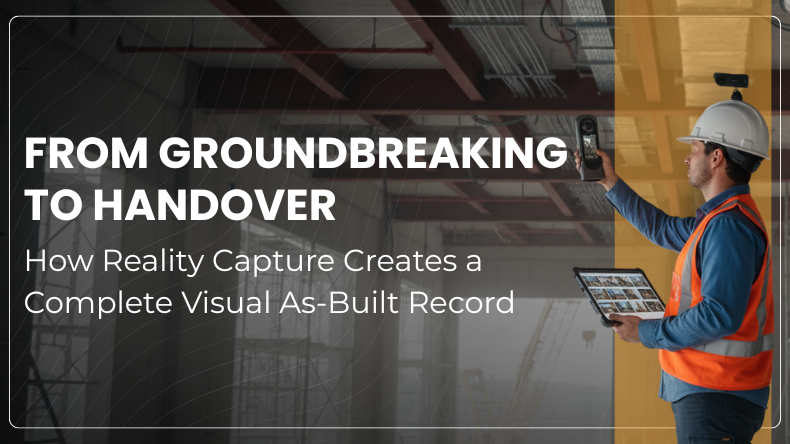
Reality Capture is a formidable solution that uses technology including, drones, LiDAR, and photogrammetry, to provide accurate and dense scans that are converted into 3D models to document As-Built conditions.
The outcome includes a digital clone that mirrors the physical built environment. This is often called a Digital Twin, which prevents errors, enhances coordination, preserves quality, and captures each component of various construction phases.
Work Smarter, Not Harder
iFieldSmart empowers your team with AI-driven efficiency to simplify scheduling, boost collaboration, and keep projects on track.
Schedule a MeetingDefinition of Reality Capture.
It is a powerful process that collates spatial information from physical spaces and transforms them into life-like and immersive representations in 3D space. These formats include millions of point clouds, meshes in 3D, and orthophotos. Tools used to achieve these deliverables include:
- Laser scanners.
- Drones for photogrammetry.
- Sensors equipped with LiDAR.
- Capture devices with 3600 photos.
Consistency in these scans or records at every project stage serves as a visual document or deliverable that illustrates what is actually built – how and when.
What is its importance for general contractors and other participants?
Clarity in monitoring project progress.
Reality Capture supports personnel in conducting regular scans to corroborate project progress through visualization transparency. Instead of depending on data silos like incomplete photos and long records, teams can leverage immersive walkthroughs of the site in any mode – physical or remote. This helps stakeholders to understand what is left and what is complete.
For example:
Reality capture can provide visual evidence for disputes or maintenance through scans before pouring concrete. This creates a transparent visual for rebar layout and underground facilities.
Prevent coordination problems.
Side-by-side comparison of the 3D model vs real-world conditions helps the general contractor flag installation issues or conflicts faster. This preemptive approach lowers rework and project delays.
For example:
Time and cost can be saved through the visualization of mechanical duct routing, which shows differences from the original plan. This can save on a lot of rework and labor resources before the drywall is installed.
Achieve compliance and quality assurance.
Reality capture delivers documentation visualization to achieve permits, inspections, and safety checks. It assures the installation was done as per code and specifications – minus the guesswork.
For example:
Evidence for compliance without using invasive techniques can be achieved by documenting fire-stopping details within walls before they are concealed.
Generate As-Built drawings that are precise and reliable.
Rather than depending on obsolete annotations or inconsistent sketches, a visual record set by Reality capture processes and tools provides a life-like representation of the built asset in 3D space which is then used for future sourcing.
For example:
A healthcare facility can use an accurate and data-rich 3D model of coordinated and clash-free MEP systems that help with upgrades and retrofits in the future.
Reduce project claims and differences.
If there exists a dispute on what was built and the timeframe it was built at, a date and time-stamped scan can help as a visual record. This prevents costly legal problems and expedites issue resolution.
Use case on healthcare expansion using Reality Capture.
Project: Addition of an additional wing in the hospital.
Personnel involved: General contractors, MEP personnel, architects, and owners.
Obstacles: The expansion had to be done without stopping operations of the healthcare facility, using non-invasive techniques. Every MEP component had to be stitched to the existing building, and the client had demanded lower rework and comprehensive as-built documentation for facilities management.
The solution:
The general contracting company used a workflow that included Reality Capture for the entire duration of the project. The scan performed initially captures existing structural features and utilities routing. As the construction moved from one phase to another, drones were deployed and hand-held scans were used to record slab pours, structural framing, and MEP installation.
The outcome:
- RFI reduction by 60%.
- Lower rework on critical systems.
- Delivery of precise as-built records to an accuracy of +-5mm.
- Owner satisfaction rate of 10/10.
What are the applications of Reality Capture?
To realize higher project value, general contractors can deploy Reality Capture processes and tools at various stages of the project lifecycle.
- Preconstruction: Document as-built site conditions.
- Early construction phase: Scan underground work, slabs, and foundations.
- Middle-phase: Enable documentation for MEP rough-ins, structural framing, and component installations.
- Pre-closeout: Capture complete conditions to realize final built documentation.
- After handover: Help with facilities management, renovations and, retrofitting in the future.
Combining the field with BIM creates a potent combination.
Reality Capture capabilities can be extended when aligned with BIM processes and tools. Reality Capture through Scan to BIM helps general contracting and surveying teams:
- Transform scanned point clouds to accurate Revit 3D models.
- Perform comparisons of the required scope with as-built scans (As-built reality vs 3D model).
- Utilize 3D data within a coordination meeting to solve problems in a collaborative setting.
- Build comprehensive As-Built 3D models and handover to clients.
This combination transforms Reality Capture into a coordination, documentation, and quality assurance tool.
Heading to a conclusion.
Reality Capture is no longer an option, but an absolute need for general contractors and surveying firms to enable faster and intelligent construction, renovation, and retrofitting. It provides significant benefits through an accurate and detailed visual record that generates greater value in the long-term, which means groundbreaking to handover and beyond.