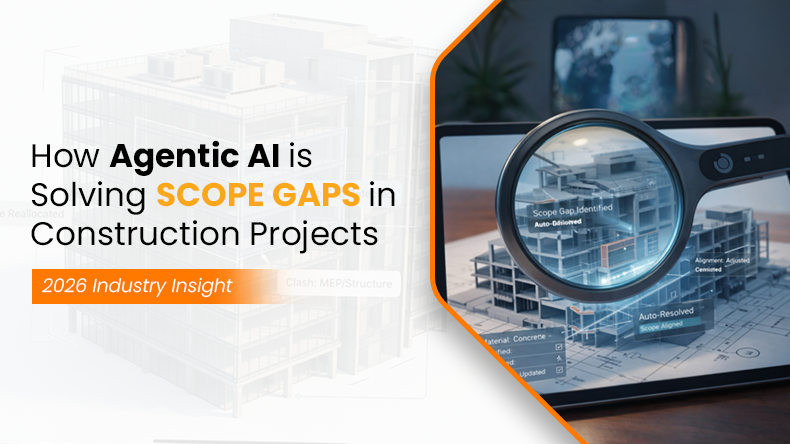


Scope gaps in construction projects are one of the most common and costly problems during pre-construction. However, they rarely appear clearly until work is already underway.
You’re deep into bid review. Drawings are open across multiple screens. Specifications sit in another tab. Someone asks, “Who’s carrying the firestopping scope here?”
No one answers right away.
Work Smarter, Not Harder
iFieldSmart empowers your team with AI-driven efficiency to simplify scheduling, boost collaboration, and keep projects on track.
Schedule a MeetingYou scroll through sheets. Check notes. Cross-reference specs. It should be there, but it’s not obvious. Maybe it’s implied. Maybe it was assumed. Maybe it’s missing entirely.
This is how scope gaps in construction silently take shape, not through major mistakes, but through small disconnects between drawings, specifications, and business responsibilities. Tools like Scope Gap Agent are now helping teams identify these gaps earlier by connecting drawings, specifications, and trade responsibilities in one place.
By the time these gaps are discovered, they have already begun to affect coordination, costs and deadlines. And despite multiple reviews, they’re still easy to miss.
What Are Scope Gaps in Construction?
Scope gaps refer to missing, unclear, or unassigned responsibilities across drawings, specifications, and trades. In construction, scope gaps don’t usually come from big mistakes. They come from small, missed connections.
A detail shown in drawings but not clearly tied to specs. A responsibility implied but not assigned. A scope that falls between two trades.
The tricky part? Everything appears to be “reviewed.”
You’ve checked the drawings. Cross-referenced specs. Assigned trades. Built scope manually. Then reviewed it again.
Yet uncertainty still lingers around:
- Who owns what
- Where trades overlap
- What might be missing entirely
This isn’t carelessness. It’s the nature of how scope is built today.
Why Do Scope Gaps Occur in Construction?
The traditional workflow asks teams to manually stitch together the scope from disconnected information.
Drawings define design intent, while specifications define execution requirements; when these aren’t aligned, scope gaps emerge. Notes add context. RFIs fill in blanks. And people, estimators, PMs, and executives, are left to connect it all.
But here’s the issue:
No one is working with the whole picture at once.
Instead, teams are forced to:
- Read documents line by line
- Interpret intent across formats
- Carry mental context across hundreds of pages
- Rebuild scope manually from scratch
Even the most seasoned experts may overlook something due to the fragmented nature of the process rather than a lack of expertise. Poor information flow continues to be one of the main causes of inefficiency in building projects, according to industry study.
A shift in thinking: from reviewing documents to interacting with data
What’s changing in 2026 isn’t just technology; it’s how teams approach scope itself.
Instead of digging through documents, teams are starting to interact directly with their project data.
This is where agentic AI is changing how teams manage scope gaps in construction.
Unlike traditional tools that wait for input, agentic AI actively works through drawings and specifications, connecting details across them and surfacing what matters.
It doesn’t replace your workflow; it changes how you move through it.
Where Agentic AI fits naturally into this workflow
Think of it this way: your drawings and specs don’t change.
But how you work with them does.
With systems like Scope Agent by iFieldSmart AI, the process shifts from manual compilation to guided understanding.
Instead of asking, “Did we miss anything?” you start asking:
- “Show scope gaps across trades.”
- “Where do mechanical and electrical overlap?”
- “What responsibilities are undefined?”
This helps teams detect scope gaps in construction before they impact cost, coordination, and schedule. Instead of digging for answers, teams get structured, traceable insights linked back to actual drawings and specifications.
What this looks like in practice
Imagine uploading your project documents.
The system begins analyzing, not just reading but also understanding, the relationships among drawings, specifications, and scope elements.
It traces details across sheets. Matches spec requirements to design intent. Identifies where something appears in one place but not another.
Then, it flags issues early.
Not vague alerts but specific, contextual findings like:
- Gaps in structural scope
- Missing coordination between trades
- Unassigned responsibilities tied to spec sections
At the same time, it builds structured scope outputs in the background, organized, usable, and ready for downstream use. In simple terms, it turns disconnected documents into structured, traceable scope intelligence.
How it works?
From the standpoint of the user, the procedure is simple. Uploading drawings and specifications is the first step. That’s it.
The AI begins analyzing the documents as a connected system. It recognizes the relationships between them rather than treating them as distinct files. It recognizes scope items, connects them to transactions, and tracks them throughout documents as it analyzes the data. It reacts with structured responses rather than just text when you interact with it by evaluating outputs or asking inquiries. Everything is tied back to source documents, so you’re not guessing.
Finally, it compiles the scope into formats you can actually use, whether that’s trade-specific scopes, gap reports, or contract-ready exhibits.
No reformatting. No rewriting. No second pass just to “make sure.”
What actually improves on the ground
The biggest shift isn’t speed, it’s clarity.
When scope gaps in construction are identified earlier, everything downstream changes.
You start to see:
- Fewer scope gaps because they’re caught during preconstruction
- Reduced trade overlaps that usually surface during buyout
- Less back-and-forth between teams trying to clarify intent
- More confidence when finalizing contracts
- Stronger alignment between what’s drawn, specified, and assigned
It also changes decision-making. Instead of relying on assumptions, teams work from what’s actually in the documents.
A better fit for how teams already work
One of the reasons this approach is gaining traction is simple: it doesn’t force teams to change everything.
It fits into existing phases like:
- Bid review
- Scope validation
- Buyout preparation
- Contract documentation
There’s no extra layer of work. It runs alongside what teams are already doing, just with better visibility. And that’s key. Because in construction, tools only stick if they respect how work actually gets done.
Platforms like iFieldSmart AI are making subtle but important improvements to how teams manage scope. They’re not trying to replace estimators or preconstruction teams. They’re removing the friction that slows them down.
By turning static documents into interactive, structured data, they allow teams to move from searching to understanding. And that’s where real efficiency comes from.
Looking ahead: the new standard for scope
As projects become more complex, the uncertainty is shrinking.
Owners expect tighter budgets. Schedules leave less room for error. And teams can’t afford to “figure it out later.”
The industry is moving toward a model where:
Scope isn’t just reviewed, it’s verified.
Agentic AI will likely become a standard layer in preconstruction, much like BIM did years ago. It solves a real, persistent problem.
FAQs (Frequently Asked Questions)
1. What are scope gaps in construction?
Scope gaps occur when responsibilities across project documents and trades are unclear or incomplete, leading to confusion, rework, and delays.
2. Why do scope gaps occur?
They occur due to disconnected documents, manual workflows, and a lack of visibility across project data.
3. How does agentic AI help reduce scope gaps?
Agentic AI analyzes drawings and specifications together to identify inconsistencies and missing scope early.
4. When should scope validation happen?
During preconstruction, especially during bid review and before buyout.
Final thoughts
Scope gaps won’t disappear overnight. Construction will always involve complexity, interpretation, and coordination.
But the way we handle that complexity is evolving.
What used to depend entirely on manual effort and experience is now supported by systems that can see across the full picture, consistently, accurately, and at an early stage.
And when teams stop guessing the scope and start defining it clearly, the entire project stands on stronger ground. And in a world where margins are tight and complexity is increasing, this change is not optional; This is rapidly becoming the new standard.
The difference now is simple: teams no longer have to rely on assumptions; they can work with clarity from the very start.
Curious how this works on real project data?
Join the waitlist for Scope Gap Agent and be among the first to explore how teams are identifying scope gaps earlier, before they impact cost, coordination, and schedule.