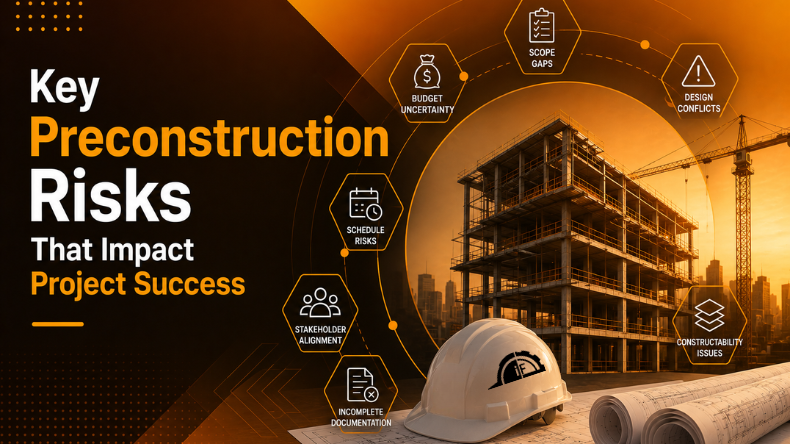


Preconstruction is quiet compared to the jobsite. No noise, no dust, no crews yelling across floors. But this is where most problems are born.
Long before concrete pours or steel rises, choices get locked in. Some are carefully considered. Others are rushed. Some seem harmless at the time, then create problems later.
Preconstruction risk management is the practice of catching these issues. At the same time, they’re still cheap to fix — before design gaps, scope confusion, unrealistic budgets, and unverified site conditions turn into jobsite delays and change orders. It works alongside disciplined constructability review, realistic construction scheduling, and early site investigation to give teams a real shot at controlling cost and schedule instead of reacting to them.
Work Smarter, Not Harder
iFieldSmart empowers your team with AI-driven efficiency to simplify scheduling, boost collaboration, and keep projects on track.
Schedule a MeetingPreconstruction risk doesn’t announce itself. Lost in review or casual decisions and unwritten small assumptions, oversights in project work quickly accumulate. By then it becomes difficult and expensive to go back and make adjustments. That’s why this phase sets the tone for everything that follows.
Here’s a walk-through of the risks that quietly live in preconstruction — and shape whether a project succeeds or struggles.
Design That Looks Right but Does Not Work
Design risk often starts with drawings that feel finished but aren’t ready. Plans look clean, lines align, notes sit in place — but buildability gets missed. That gap between what can be drawn and what can actually be built causes real pain later.
Some details are hard to spot at first glance. Clearances that work on screen fail on-site. Systems overlap without room to breathe. Structural elements block access. None of this looks dramatic on paper. It’s subtle — and it multiplies once construction starts.
Design reviews sometimes move too fast because teams want to stay on schedule and trust issues will “get sorted later.” That hope rarely pays off. When reviews check only whether a drawing looks correct instead of whether it works in the real world, crews end up solving problems that should’ve been caught months earlier.
Good preconstruction slows design review down on purpose, and asks the questions that actually matter: Can this fit? Can someone install it safely? Can it be maintained later? These three questions can expose problems that a document-focused review may miss. This is the core of a strong design coordination and constructability review process.
Missing Details That Trigger Big Delays
Small gaps in drawings cause outsized trouble. A missing section detail. An unclear finish note. A vague dimension. These feel minor during planning. On-site, they stop work cold.
Crews can’t guess. They wait. RFIs pile up. Schedules slip a day at a time — and that waiting costs money and creates tension between teams who feel blocked by someone else’s oversight.
This risk usually traces back to rushed documentation. Deadlines push drawings out the door before a full check happens, and everyone assumes someone else will catch the gap. Often, no one does.
A careful document review process during preconstruction catches these holes early. It costs time up front — and saves weeks of it later. That trade is almost always worth making.
Scope That Lives in Assumptions Instead of Writing
Scope risk shows up when work is implied instead of stated. One team assumes a task is included. Another assumes it isn’t. Both are confident in their interpretation. That difference is exactly where disputes start.
These gaps hide in language. Phrases like “by others” or “as required” sound harmless. They aren’t. They push responsibility into gray space, and that gray space becomes conflict once work begins.
Scope gaps show up hardest between trades, where each group focuses on its own work, and interfaces get missed:
- Who installs the sleeves?
- Who seals the openings?
- Who handles temporary supports?
If no one owns a task explicitly, it waits — usually until it’s blocking someone downstream.
Clear scope writing shrinks this risk. Not perfect writing — just honest, direct language that spells out what’s included and what isn’t. Silence creates risk. Clarity removes it.
Budgets Built on Hope Instead of Reality
Cost risk is always present. Early budgets rely on estimates, and estimates rely on assumptions — some of which hold, and some of which fall apart fast.
Material prices shift. Labor markets tighten. Fees rise. Early numbers often lag what’s actually happening in the market by the time construction starts.
Teams also underestimate complexity more often than they’d admit. A detail that looks simple on paper can turn out to be difficult to install, and that added effort costs real time and money. If the budget never accounted for it, the pressure lands on the project team later, not the estimator.
Good preconstruction budgeting and cost estimating lean on current data — real quotes, real labor input — and leave room for the unknown. Not because the team expects failure, but because construction is never static.
Ignoring cost risk early doesn’t save money. It only delays the moment the real number shows up.
Schedules That Ignore How Work Actually Flows
Schedule risk often comes from optimism. Dates get set to satisfy a goal rather than reflect reality, and tasks stack tightly with no breathing room — so one delay triggers several more.
Construction doesn’t move in straight lines. Permits take time. Reviews stretch longer than planned. Weather interferes. Deliveries slip. A schedule that assumes perfect flow is a schedule that invites failure.
Preconstruction schedules should reflect how work actually happens — not how it looks on paper. It is useful to speak with the field teams directly since they know where bottlenecks occur and can identify tasks that will be blocked until other tasks are completed.
Building buffer time into a schedule isn’t laziness. It’s realism. It’s what lets a team respond to a shift without the whole project going into panic mode. This is where good construction progress tracking and sequencing earns its keep.
Communication That Breaks Under Pressure
People talk constantly during preconstruction — meetings happen, emails fly, files move around — yet communication risk still runs high.
Information often lives in silos. One update reaches some people but not others. Different versions of the same drawing circulate at once. Decisions get made verbally and never get written down.
Later, no one remembers who agreed to what. Disputes follow. Trust erodes.
This risk grows worse when teams use too many disconnected tools, or none at all, and information slips through the cracks between them. The fix isn’t more tools — it’s a single source of truth, shared access, and simple, consistent rules about how updates get recorded. A connected construction project management platform does most of the heavy lifting here.
Permit and Code Surprises
Rules matter. Codes matter. Permits matter. Ignoring project deadlines early helps no one and will only result in a lengthy delay.
Some teams assume approvals will move quickly because they did on the last project. But requirements shift by jurisdiction, by authority, and by scope — experience isn’t a guarantee.
Late discovery of a permit issue stops work outright. Redesigns follow. Costs rise. Schedules stretch in ways that are hard to recover.
Preconstruction should flag these risks early: identify every approval needed, check realistic timelines, and talk with the relevant authorities directly when possible. Waiting only increases exposure.
Material Availability That Gets Overlooked
Material risk feels distant during planning. Everything looks available in a catalog, and lead times look short — that sense is often wrong.
Some materials take months to arrive. Suppliers face shortages. Global supply issues ripple into local jobs without warning. When materials show up late, crews wait — and idle time drains both budget and morale fast.
Early, honest conversations with suppliers reduce this risk. Get real lead times, not catalog estimates. Identify alternates before you need them. Planning around material reality — not material hope — keeps work moving.
Contracts That Leave Too Much Open
Contracts shape behavior. When language is vague, conflict grows. When roles are unclear, disputes follow.
Some contracts bury key terms in dense text. Others get rushed through review to meet a deadline. Later, those same words get pulled apart in an argument neither side saw coming.
Change handling is the most common flashpoint: if a contract doesn’t clearly state how changes get priced and approved, teams clash the first time a change actually happens.
Strong preconstruction includes a careful contract review — not just a legal check, but a practical one. Do these terms match how the project will actually run? If not, the risk stays exactly where it was.
Quality Risks Set Before Work Begins
Quality doesn’t start on-site. It starts in preconstruction.
If standards are unclear, work varies from crew to crew. If details are weak, installs suffer. Fixing a quality issue after the fact always costs more than preventing it would have.
Rushed planning tends to cut quality checks first — and that choice backfires every time. Rework becomes inevitable with poor-quality work. Rework burns both your scheduling and budgetary resources.
Defining standards coupled with the review of details and confirmation of verified materials is useful in minimizing rework. This process should be slow and deliberate enough to ensure performing the work correctly the first time.
Unknown Site Conditions
Ground risk hides until someone digs. Soil issues, water tables, old utilities — these surprises can derail a schedule quickly, and they’re among the most expensive risks to discover late on this list.
Saving time or money by removing site investigation is a common mistake, as the risk doesn’t go away, but is shifted to a more costly stage of the project.
Conducting proper geotechnical and site investigations during the preconstruction phase reduces the range of likely surprises, even though complete removal of the unknown variables is not possible. The team is then able to develop a well thought out response, as opposed to an emergency response, to the unknowns that do occur.
Technology Used Without Alignment
Tools can help or hurt. When teams use different systems, data conflicts. Old versions of files linger. Errors slip through unnoticed.
Adoption of technology increases risk when users don’t receive training or a projection for how to use new tools. Without a clear process, users circumvent a tech system.
Before constructing anything, define clear guidance on the tools like iFieldSmart’s software version controls, processes for modifying/editing drawings and models, and project data ownership. Simple structure keeps information clean and the whole team aligned.
Why These Risks Matter More Than They Seem
Each risk looks manageable alone. Together, they compound.
One missed detail leads to a change. That change affects cost. Cost pressure affects the schedule. Schedule stress affects quality. The chain reaction usually starts small — and that’s exactly what makes it dangerous.
Projects struggle when multiple risks accumulate and the team does not have enough time, money, or resources to absorb their impact.
Preconstruction is the best chance to break that chain. It’s the last calm moment before momentum builds — and the choices made here echo through every phase that follows.
A More Grounded Way Forward
No project avoids all risk. That was never the goal. The goal is awareness.
Ask more questions early. Slow down reviews. Listen to the people who will actually build the work. Write things down clearly. Share information openly. Leave room for change.
Preconstruction works best when teams stay curious — when they admit what they don’t know instead of rushing past the uncertainty.
That mindset doesn’t guarantee success. But it gives a project a fair shot. And in construction, that matters more than most people admit.