

Groundbreak 2026 kept coming back to one question: what can AI do on a live project this month? The opening keynote, “Built on Intelligence,” and the closing keynote, “From Intelligence to Impact,” were bookends on two days of sessions that moved past demos and into deployment.
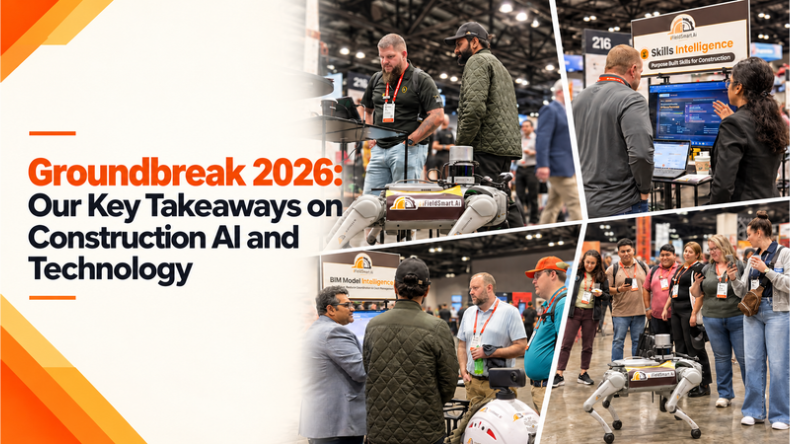
At iFieldSmart AI booth (#1216), we met GCs, subcontractors, owners, BIM/VDC leads, and an architect or two. Over two days, 56 builders fired more than 100 unscripted questions at our AI, which we’d configured with a sample project package. Here’s what we took away from the sessions and the booth.
The stakes are easy to state. A slow RFI answer holds up an install. A clash found after the pour eats weeks. Teams that act on this now will spot problems sooner and pay for less rework.
Work Smarter, Not Harder
iFieldSmart empowers your team with AI-driven efficiency to simplify scheduling, boost collaboration, and keep projects on track.
Schedule a MeetingKey Insights
Builders stopped asking and started delegating
The “Invisible Interface” session pictured people telling an agent the outcome they want instead of clicking through menus. We watched that shift happen at the booth. On Day 1, 7 of 52 questions asked the AI to produce something — a scope of work, a list of action items, a compliance check — rather than just explain something. On Day 2, that number climbed to 18 of 48.
The requests got specific fast:
- “Write an electrical scope based on the drawings.” Five different builders asked for a scope of work.
- “Run compliance on the paving certificates submittal.” The demo package scored 0% because it contained HVAC documents instead of the required paving documentation.
- “Summarize the OAC meeting with action items.”
A companion session on business value added a useful caution: pilots only matter when they tie to measurable outcomes.
Why Human Approval Matters
Speakers kept circling the same tension. AI works fast, but construction risk is too high to let it act alone. The pattern that held up pairs the AI’s analysis with an expert who checks it.
Our booth got the sharpest version of this from a GC who stopped mid-demo to ask whether the AI would email anyone on its own. It won’t. It drafts, and you approve before anything leaves the building.
Where the model meets the field
A digital delivery session at NIBS linked BIM, digital twins, robotics and process automation around one idea: models drift from what’s built, and problems collect in the gap.
We showed that gap live. Our AI checked Level 3 sleeves ahead of a concrete pour, flagged the misplaced and missing ones against the BIM model, and suggested a fix for each. Another visitor asked to see the same check on MEP clashes. Same workflow, different data.
The bottleneck is finding things
An early session on RFIs, submittals and daily logs made a point we heard all week: most teams already have the information. They just can’t find it fast enough. RFI questions topped our list too, with more than a quarter of all questions asking the AI to locate or summarize something from the project documents.
Four technologies, one workflow
Each of these technologies offers value to the construction industry. However, their greatest power is realized when used in conjunction with other complementary technologies as part of a unified connected workflow.
- Agentic AI processes drawings, specifications, RFIs, and logs, and produces actions such as scope of work and/or compliance checks, as well as answers to RFIs.
- Integration of BIM and VDC might be useful when trying to make design intentions correlate with the construction site. Through comparison of digital models and real-life conditions at the jobsite, it becomes easy to find discrepancies and correct the course before getting to the next stage.
- Reality Capture creates evidence of the physical world. 360-degree photos or drone captures of a jobsite, or even laser scanning, can create a baseline of the jobsite condition and even contribute to the identification of issues in the facility’s conditions or areas where it is impossible to access physically.
- Connecting the Dots Across Projects. When project data, models, and field captures are connected and integrated, AI can check a submittal against the spec it is governing or compare a model to captures for deviations in real time.
We demonstrated how BIM could show the location of sleeves, field data could verify their location, and Agentic AI could identify the differences and suggest solutions.
It is clear that while individual technologies can help solve isolated problems, integrating all the project information can give a more comprehensive and holistic view, and more importantly, lead to solutions that are actionable on a project.
Learnings and Takeaways
Conference notes only matter if they change Monday morning. Here are the problems we heard most, with a first move for each.
- Slow access to information
The answer exists, but finding it eats an hour. First step: time how long it takes to answer a question like which spec revision changed a requirement. That’s your baseline. - Software silos
One change gets retyped across drawings, RFIs, photos and the schedule. First step: trace one submittal through every system, count the handoffs and cut one. - Late surprises
Model-versus-field mismatches surface after the next trade builds around them. First step: run a check at two or three milestones and log what it finds. Start in the mechanical room. - Poor jobsite visibility
One-time scans nobody repeats leave gaps. First step: pick a 360° capture schedule your crew will keep and give one person ownership. Run the first capture this week. - Risks that show up late
Trouble usually appears after the cheap options are gone. First step: review your last three projects and mark where problems surfaced late. Then watch past-due RFIs and late trades in those same spots on your next project. - Making AI Pilots Work on the Ground
AI pilots can lose momentum without clear ownership and measurable results. Begin small by focusing on one weekly task, like submittal reviews, and assigning a point person. After two weeks, review the results and decide whether to expand.
What This Means for Your Role
Project managers spend less time performing research and more time making informed decisions.
Superintendents gain a better understanding of the conditions on the site and what work will be performed in the future and can plan and coordinate the work of subcontractors better.
VDC leads can make model-versus-field checks a standing milestone task.
Owners can ask whether the contractor corrected what an RFI requested, instead of waiting on another status report.
Whatever your role, verify critical AI output and approve every draft before it goes out.
Conclusion
Groundbreak 2026 showed how connected teams, data, and workflows can make a difference. Teams that can connect information in design and construction documents to evidence seen in the field have the greatest chance to avoid that problem.
That’s the workflow we build at iFieldSmart AI, and each piece answers a problem from this post:
- Finding information across drawings, specs and RFIs: our agentic AI skills.
- Understanding actual site conditions: Lens360, which turns 360°, drone and laser-scan captures into reports you can act on.
- Catching gaps between plans and installed work: our VDC and mixed reality tools.
You stay in control of everything that goes out.
Need to solve a project challenge? Be it an RFI delaying an installation, a clash discovered too late, or a field condition that does not match the model, iFieldSmart AI can connect project information to give your team the right data at the right time.
Have a challenge? See how iFieldSmart AI can help you solve it.