

Introduction.
In a construction landscape driven by time and cost, providing high-quality projects can be challenging as it latches onto seamless and accurate documentation and communication. One of the leading advancements in the present day is the application of 3600 – photo documentation integrated with RFI workflows. Combined, it has become a transformational tool to enhance the quality of a project, accountability, and coordination across various project lifecycles.
Let’s explore the significance of stitching RFIs to 3600 photographs to improve the quality of a project.
What is the meaning of an (RFI) Request for Information and why is it important?
Request for Information (RFI) is a formal document that is raised to gain better clarity about a project element, system, or process, realize approvals, or seek design data during the construction process. RFIs are important as they:
Work Smarter, Not Harder
iFieldSmart empowers your team with AI-driven efficiency to simplify scheduling, boost collaboration, and keep projects on track.
Schedule a Meeting- Resolve interferences between job site conditions and 2D drawings.
- They are useful in transmitting ambiguities or modifications.
- Ensure project teams align with the required scope and installation.
However, legacy RFI workflows are content-heavy and lack visual scope, and leading to project delays due to lacking communication and cluttered documentation.
What is the role of 3600 photographs in the construction sector?
360-degree photos are used to document panoramic and immersive visualization of a construction site at multiple phases. Unlike static images or drawings, they help with:
- Complete spatial awareness of the surrounding spaces.
- A detailed walk-through of existing conditions.
- Location-driven and time-stamped visual information.
360-degree photo documentation facilitates a single source of truth that enables participants to access site conditions from remote areas and devices.
Closing the gap by connecting 360-degree photos with RFIs.
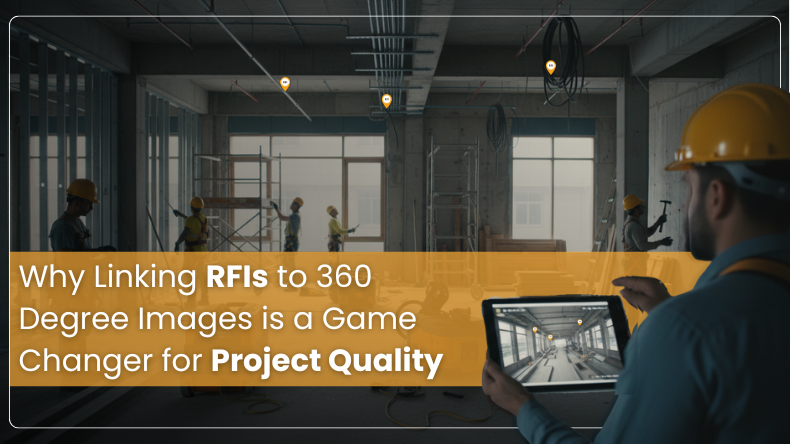
Integrating RFIs into 360-degree photos using pins, tags, or linked annotations helps teams navigate through digital copies of the actual job site and get complete access to RFIs at a location where they are important – in the scope of the problem.
Linking RFIs to 360-degree photos resolves various obstacles and improves project quality in various ways.
Greater improvements in project clarity and quick RFI resolution.
When RFIs are raised and stitched to required visual locations in a 3600 image, discrepancies are removed. Stakeholders including contractors, designers, and engineers can no longer have to guess about the issue’s location or what it seems like.
For example:
Instead of obsolete reading methods like: “Corridor B2 has a mismatched duct alignment”. A user or client can visually travel to the said corridor in a 360-degree photo and assess the real condition with linked RFIs.
What is the impact?
- Quick issue identification.
- Reduction in monotonous communication.
- Clarity in decision-making.
Enhanced collaboration between various teams and clients.
For large-scale projects and various stakeholders, the need to access information in real time is important. 360-degree photos that are linked by RFIs also enable a visual space that is shared, and where everyone can:
- Review contextual issues.
- Include markups or comments.
- Take collaborative calls from any location.
This freedom of data visualization dissolves data silos and ensures a centralized understanding of existing field conditions, which leads to focused and informed decision-making.
Higher project accountability and elevated Quality Assurance.
Every RFI that is linked becomes part of an audit trail that is visual and enables a greater understanding of issue tracking, deciding parameters, and the time it was resolved. When RFIs are raised using immersive images, teams can –
- Pinpoint issues in the required quality.
- Hold higher accountability based on faster resolution.
- Justify decisions for regulators and clients.
What is the impact?
- Higher accountability.
- Greater client satisfaction.
Significant rework reduction and minimal change orders.
A large level of cost overages and project delays erupts from costly rework which is driven by unchecked details and miscommunication. When RFIs are stitched to 360-degree photos, job site teams can quickly assess the scope of the problem, which lowers the chances of miscommunication.
Furthermore, design or coordination modifications that stem from RFIs are documented visually, which ensures dispute reduction and errors at various project phases.
Faster integration with BIM tools and construction management platforms.
Present-day construction platforms like Lens360 support 360-degree photos and RFIs to be stitched with BIM and scheduling tools. This complete ecosystem provides:
- Context-driven coordination between the digital 3D model and actual site conditions.
- Quick updates to documents and 2D drawings.
- Optimized interference detection and resolution.
The linking between deliverables like 360 photos, RFIs, and BIM tools facilitates data-driven decision-making which reduces construction risks and improves the quality of the build.
Gives rise to QA/QC workflows that are seamless.
Quality Control and Quality Assurance processes can leverage advantages from this combination or integration. These advantages include:
- RFIs can be logged by inspection teams using virtual walkthroughs based on 360-degree photos.
- Deficiencies are flagged using visual models and assigned for resolution.
- RFIs can be closed and validated by comparing 360 images.
This depth of integration produces a closed loop that enhances visibility from identifying issues to resolving them.
Heading to a conclusion.
The construction sector is transforming rapidly, and so are the methods that are used to manage data. Stitching 360-degree photos to RFIs converts them from isolated and static documents to spatial dynamic communication platforms. This level of integration:
- Would enhance clarity.
- Lower errors.
- Expedite decision-making.
- Enhance the quality of the build.
- Reduce costly rework.